



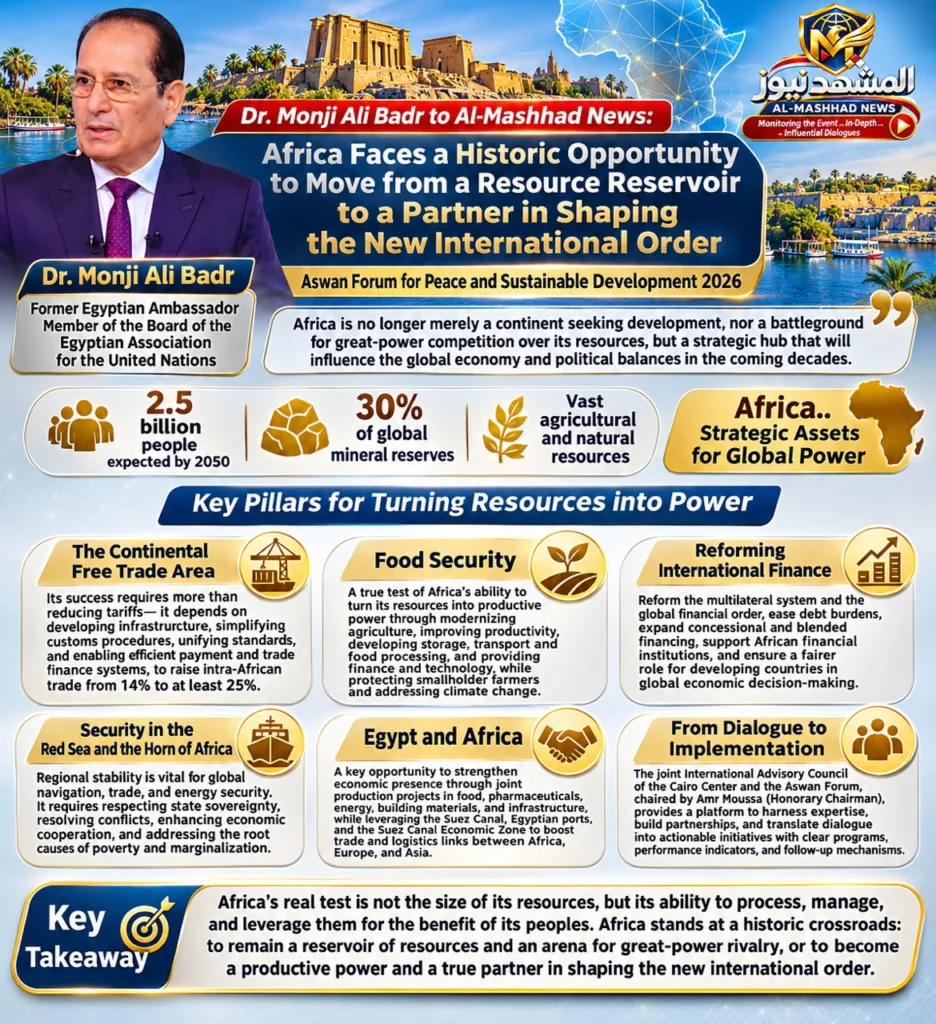
Africa is no longer merely a continent seeking development or an arena where major powers compete for control over its natural resources. It has increasingly become a strategic center capable of influencing the global economy and international political balances over the coming decades.
Against the backdrop of escalating geopolitical tensions and changing patterns in energy, food security, and global supply chains, the sixth edition of the Aswan Forum for Sustainable Peace and Development, held on November 21–22, 2026, takes on particular significance.
The forum raises a question that goes beyond traditional discussions of development: How can Africa move from being affected by the rules of the international system to becoming an active participant in shaping them?
Africa’s Vast Resources and Its Growing Global Strategic Importance
Africa possesses enormous mineral and agricultural resources, alongside a young and rapidly growing population expected to approach 2.5 billion people by 2050. The continent also holds approximately 30% of the world’s mineral reserves, according to widely cited international estimates.
However, abundant natural resources do not automatically translate into economic development. The fundamental challenge lies in limited industrial capacity, inadequate infrastructure, high financing costs, restricted technology transfer, and ongoing armed conflicts in several parts of the continent.
These challenges continue to prevent many African countries from fully benefiting from their economic potential.
Reforming the International Financial System: A Key Priority for Africa
The messages delivered by Egyptian President Abdel Fattah El-Sisi during the Aswan Forum reflected the growing importance of reforming the multilateral system and the international financial architecture, while strengthening Africa’s participation in shaping global rules rather than simply adapting to decisions made outside the continent.
These demands have direct economic implications, as many African countries face mounting debt burdens and high borrowing costs, limiting their ability to finance essential sectors such as education, healthcare, and infrastructure.
Providing new financing alone is not sufficient. What is needed is a comprehensive reform of financing conditions, broader access to concessional and blended finance, stronger African financial institutions, and fairer opportunities for developing countries to participate in international economic decision-making.
Food Security: Turning Agricultural Resources into Productive Strength
Food security represents another major test of Africa’s ability to transform its natural resources into sustainable productive capacity.
Owning vast areas of agricultural land and water resources is not enough without modernizing farming systems, improving productivity, developing storage and transportation infrastructure, and expanding food processing industries.
This transformation also requires access to financing and modern technology, while protecting smallholder farmers and addressing the growing impact of climate change.
Developing a resilient agricultural system is essential to strengthening Africa’s ability to withstand global crises and disruptions in food supply chains.
The African Continental Free Trade Area: Building an Integrated Economic Market
The African Continental Free Trade Area (AfCFTA) represents a significant opportunity to establish an integrated continental market. However, its success requires more than reducing customs tariffs.
It depends on developing roads, ports, and railway networks, simplifying customs procedures, harmonizing standards, and establishing efficient payment systems and trade-financing mechanisms.
The ultimate objective is to increase intra-African trade from approximately 14% to at least 25%, strengthening economic integration, expanding cross-border investments, and supporting joint industrial production across the continent.
Egypt and Africa: Moving from Exports to Joint Production Partnerships
Egypt has an important opportunity to strengthen its economic presence across Africa by moving beyond the traditional model of exporting goods toward establishing joint productive ventures that create long-term economic partnerships.
Food processing, pharmaceuticals, energy, building materials, and infrastructure represent promising sectors for Egyptian-African cooperation.
Such partnerships can facilitate technology transfer, create employment opportunities, and strengthen the productive capacities of participating countries.
Egypt can also capitalize on the strategic location of the Suez Canal, its ports, and the Suez Canal Economic Zone to enhance trade and logistics connectivity between Africa, Europe, and Asia.
In addition, Egyptian companies can expand their participation in transportation, energy, water, housing, and reconstruction projects across the continent.
Red Sea and the Horn of Africa: Regional Security Is Closely Linked to Development
The interconnected security of the Red Sea, the Horn of Africa, and the Gulf of Aden represents another strategic priority.
Instability in this region does not threaten maritime navigation alone; it also affects global trade, transportation and insurance costs, and energy security, with direct implications for Egyptian interests and the Suez Canal.
Sustainable stability cannot be achieved through military arrangements alone. It requires respect for state sovereignty, peaceful settlement of conflicts, stronger economic cooperation, and addressing the root causes of poverty and marginalization.
Reconstruction, therefore, should not be limited to rebuilding what wars have destroyed. It should become an opportunity to establish stronger economies and institutions capable of preventing conflicts from recurring.
The International Advisory Council: Turning Dialogue into Practical Initiatives
The Joint International Advisory Council of the Cairo International Center and the Aswan Forum, with Amr Moussa serving as Honorary Chairman, represents an opportunity to mobilize international expertise, strengthen partnerships, and translate discussions into practical initiatives.
Achieving meaningful results requires clear programs, measurable performance indicators, and effective monitoring and evaluation mechanisms to ensure that recommendations are transformed into tangible outcomes.
Africa at a Historic Crossroads: From Resource Ownership to Global Influence
In conclusion, the real test facing Africa is not the size of its natural resources, but its ability to process, manage, and utilize them for the benefit of its people.
The growing international competition over Africa is no coincidence. It reflects the continent’s increasing importance in global energy, food, technology, and trade equations.
For Egypt, the opportunity lies in transforming its African strategic depth into genuine economic and productive partnerships, while linking regional security with development and shared interests.
Africa now stands at a historic crossroads: it can either remain a reservoir of raw materials and an arena for competition among major powers, or emerge as a productive force and an active partner in shaping the new international order.
This transformation will not be achieved through slogans or international forums alone. It requires strong institutions, deeper economic integration, investment in human capital, and the ability to turn decisions into measurable achievements.