



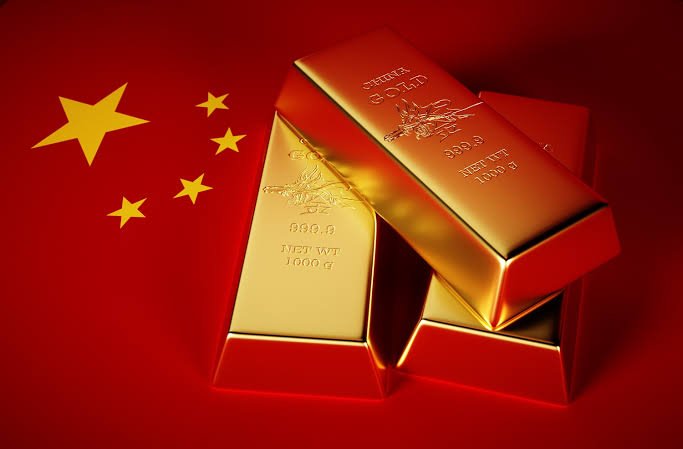
China is strengthening its strategic position in the global gold market, adding 26 tonnes of gold to its official reserves in October 2026, marking its largest monthly purchase since October 2023.
The latest increase brought the People’s Bank of China’s (PBoC) total gold holdings to 2,435 tonnes, extending its consecutive monthly buying streak to 24 months, according to the World Gold Council’s latest report, published on November 17, 2026.
The move comes amid a notable shift in China’s gold market, where investment demand for bullion and gold-backed exchange-traded funds (ETFs) is gaining importance, even as gold prices decline and futures trading activity cools.
The October figures reveal a market moving in two different directions: weaker prices and trading activity on one side, and sustained institutional and investment demand on the other.
China Accelerates Gold Purchases as Reserves Reach 2,435 Tonnes
The People’s Bank of China added 26 tonnes of gold to its reserves in October, the largest monthly increase since October 2023.
Official gold holdings reached 2,435 tonnes, accounting for 8.1% of China’s foreign exchange reserves, compared with 8.5% in September.
Despite the increase in physical holdings, the value of China’s gold reserves contracted by 5.3% during the month, reflecting the decline in international gold prices.
The continued accumulation highlights Beijing’s sustained commitment to gold as part of its reserve diversification strategy.
Chinese Gold ETFs Record Four Consecutive Months of Inflows
Chinese gold-backed ETFs attracted fresh investment for the fourth consecutive month in October, adding 6.3 tonnes, equivalent to RMB 5.3 billion, or approximately US$784 million.
Total ETF holdings reached a record 310 tonnes by the end of October, with 62 tonnes added since the beginning of 2026.
However, total assets under management declined by 4% to RMB 265 billion (approximately US$40 billion), as falling gold prices outweighed the impact of positive investment flows.
The World Gold Council attributes continued investor interest to weakness in equity markets, low government bond yields and ongoing gold purchases by China’s central bank.
Bullion Investment Reshapes China’s Gold Demand
One of the most significant developments in China’s gold market is the changing balance between jewellery consumption and investment demand.
Gold withdrawals from the Shanghai Gold Exchange (SGE) increased by 2% month-on-month to 94 tonnes in October, defying the usual seasonal slowdown following September’s strong restocking activity.
The improvement was mainly supported by stronger bullion sales, as lower gold prices encouraged investors to buy on price dips.
Jewellery retailers also remained active in replenishing inventories, supported by lower prices and healthy consumption during China’s National Day holiday.
Nevertheless, wholesale gold demand remained 24% lower year-on-year, largely due to continued weakness in the jewellery sector.
The World Gold Council highlights a broader structural shift: investment in gold bars and coins is increasingly replacing jewellery consumption as a key driver of wholesale demand.
Gold bar and coin investment exceeded jewellery consumption for the first time in history in 2025, and the same trend continued during 2026.
Gold Futures Trading Slows on Shanghai Exchange
China’s gold futures market experienced weaker trading activity in October.
Average daily trading volume on the Shanghai Futures Exchange (SHFE) declined by 28% month-on-month to 258 tonnes per day.
Meanwhile, net long positions held by the top 20 market participants fell by 15 tonnes from the end of September to 134 tonnes.
Despite the monthly decline, these positions remained 31% higher than the same period last year.
The slowdown reflected weaker gold prices and lower market volatility, which reduced bullish positioning and trading activity.
Gold Prices Extend Their Decline
Gold prices continued to fall in October, with the LBMA Gold Price PM declining by 6.3% in US dollar terms, while the Shanghai Benchmark Gold Price PM fell by 5.9% in Chinese yuan.
The World Gold Council links the weakness partly to a rotation of investment funds out of equities and gold futures and into bonds, alongside selling pressure in US trading.
By the end of October, gold’s year-to-date losses had reached 7.1% in US dollars and 9.4% in Chinese yuan.
The appreciation of the Chinese currency against the US dollar contributed to the larger decline measured in yuan.
Gold briefly rebounded in early November before prices weakened again amid changing expectations about the US Federal Reserve’s monetary policy.
China’s Gold Imports Rise 41% Year-on-Year
China’s gold imports increased to 129 tonnes in September 2026, up 5 tonnes from August and 41% higher than the same month last year.
The recovery was supported by seasonal wholesale demand ahead of the peak consumption period and favourable import incentives linked to the rising local gold price premium.
What China’s Gold Strategy Means for Global Markets
China’s latest figures point to a changing structure of gold demand.
Central bank purchases, record ETF holdings and stronger investment interest in physical bullion are providing important support to the market, even as jewellery demand and futures trading face pressure.
Looking ahead, the World Gold Council expects bullion investment to remain supported by the current macroeconomic environment. However, a sustained recovery in Chinese equities could divert some investor attention away from gold ETFs.
Jewellery consumption may also improve with seasonal demand and lower prices, although its recovery will depend on consumer spending conditions.
Conclusion: China Is Not Just Buying Gold — It Is Reshaping Demand
The addition of 26 tonnes to China’s official gold reserves is more than a monthly purchase figure. It reflects Beijing’s continued commitment to gold and highlights a wider transformation in the world’s largest gold-consuming market.
With official reserves reaching 2,435 tonnes, Chinese gold ETFs holding a record 310 tonnes, and investment demand increasingly driving wholesale activity, China is becoming an increasingly influential force in the global gold market.
As investors continue to monitor gold prices, interest rates and central bank policies, China’s strategy offers a clear signal: gold remains a central component of its long-term approach to investment and reserve diversification.