



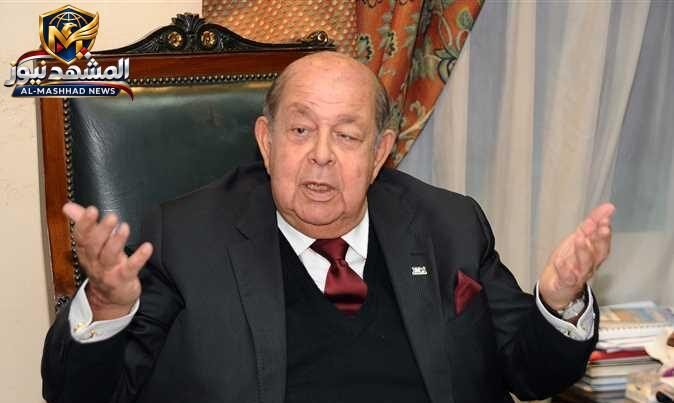
Egyptian Businessmen’s Association President Proposes Establishing a Permanent BRICA Working Group to Advance Joint Projects and International Partnerships
Engineer Ali Eissa, President of the Egyptian Businessmen’s Association (EBA), emphasized the strategic importance of strengthening industrial integration and investment cooperation among countries participating in the Belt and Road Initiative, highlighting Egypt’s potential to serve as a major hub for advancing economic and trade relations between participating nations and global economic blocs.
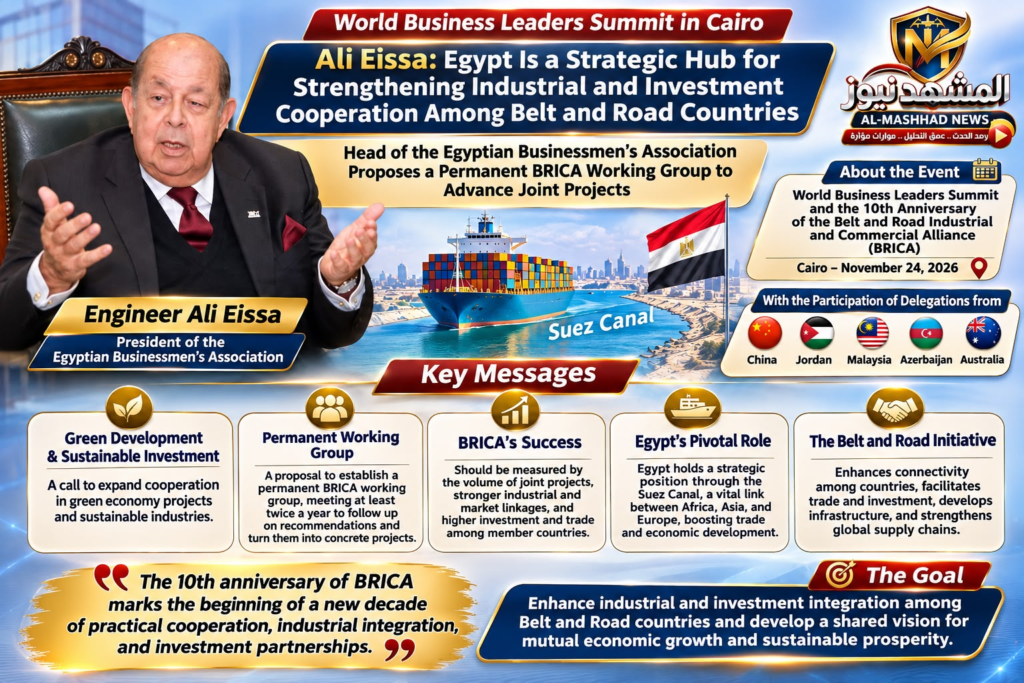
Eissa made these remarks during his opening address at the World Business Leaders Summit and the celebration of the 10th anniversary of the Belt and Road Industrial and Commercial Alliance (BRICA), held in Cairo on November 24, 2026, with the participation of international delegations from China, Jordan, Malaysia, Azerbaijan, and Australia, alongside representatives of government entities, international institutions, and business organizations.
Welcoming the participating delegations, Eissa described the tenth anniversary of BRICA as an important milestone for reviewing the achievements of the past decade and launching a new phase of deeper industrial and investment integration.
He noted that the Egyptian Businessmen’s Association was among BRICA’s founding members. The alliance was established through an initiative by the China Federation of Industrial Economics, with Egypt hosting its first conference ten years ago. Since then, a series of international conferences and events have helped strengthen communication and cooperation among business communities.
Belt and Road Initiative: A Platform for Global Economic Connectivity
Eissa explained that the Belt and Road Initiative, launched by Chinese President Xi Jinping in 2013, aims to enhance connectivity among countries, facilitate trade and investment, develop infrastructure, and strengthen links between markets and supply chains
He stressed that BRICA represents an important platform for translating this vision into practical cooperation between business communities through industrial and commercial partnerships and stronger international business networks.
He added that the initiative has become increasingly significant amid global economic transformations, the restructuring of supply chains, and changing production, trade, and investment strategies. These developments make economic integration among participating countries a strategic necessity for strengthening their competitiveness.
Suez Canal Strengthens Egypt’s Strategic Investment Position
The EBA president highlighted Egypt’s pivotal and strategic role in the Belt and Road Initiative, emphasizing its geographical position and the Suez Canal as a vital maritime corridor connecting Africa, Asia, and Europe.
He pointed out that these strategic advantages provide significant opportunities to promote economic development and expand trade cooperation between participating countries and major global economic blocs.
Eissa stressed that BRICA’s success over the next decade should not be measured solely by the number of meetings and conferences held, but rather by the volume of joint projects implemented, the extent to which industries and markets become interconnected, and the growth of investment and trade among member countries.
Ali Eissa Proposes Establishing a Permanent BRICA Working Group
In a move aimed at transforming international cooperation into tangible economic outcomes, Eissa proposed establishing a permanent working group comprising the executive bodies of business organizations participating in the Belt and Road business alliance.
The proposed group would hold regular meetings at least twice a year to strengthen coordination, develop joint action plans, monitor the implementation of conference recommendations, and translate them into concrete projects.
It would also work to facilitate cooperation and partnerships between private-sector institutions across participating countries, ensuring mutual benefits and shared economic interests.
Green Development and Sustainable Investment on the Cooperation Agenda
Eissa expressed his hope that the summit’s discussions, particularly those addressing Egypt’s position as a strategic investment hub, industrial and commercial cooperation, green development, and sustainable investment, would contribute to developing an integrated vision for shared economic growth among participating countries.
Concluding his remarks, he emphasized that BRICA’s tenth anniversary should mark the beginning of a new decade of practical cooperation, industrial integration, and investment partnerships.
He also expressed his hope that the summit would produce actionable recommendations that can be translated into concrete future objectives and projects, supporting sustainable economic prosperity for all participating countries.